
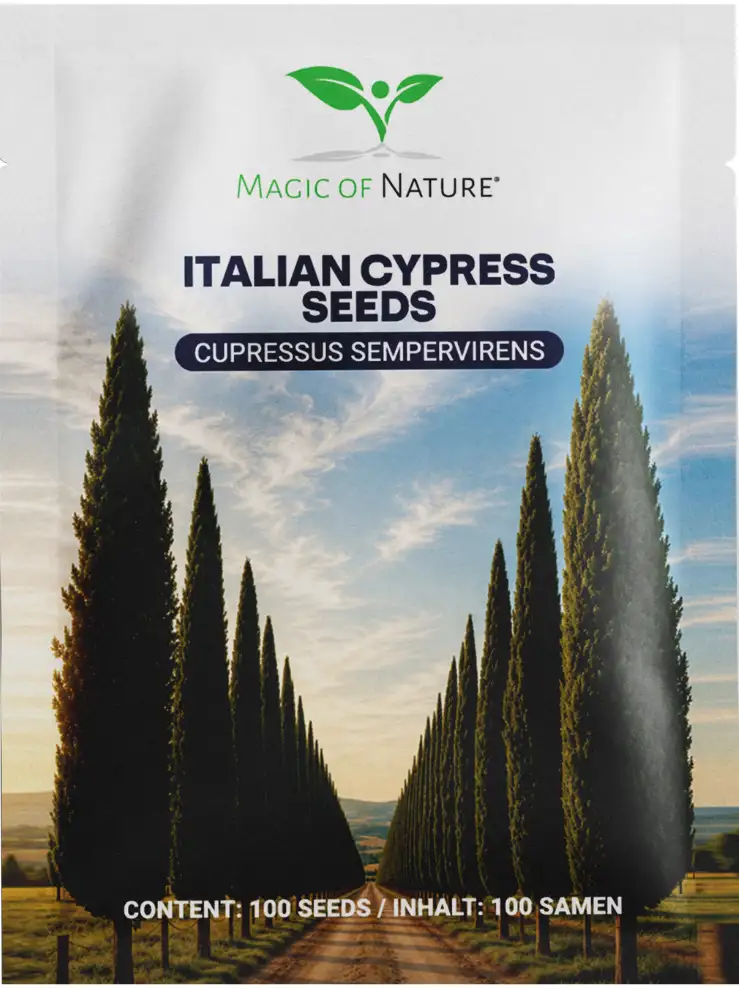
ITALIAN CYPRESS / MEDITERRANEAN CYPRESS
(Cupressus sempervirens)
PROFILE:
🛒 Available on our Etsy Shop ➔
- The classic from the Italian Tuscany – the Mediterranean cypress, also known as the Italian cypress or columnar cypress.
- Whether as a slender column in open ground or as an elegant container plant – the tree adapts to your individual wishes.
- It brings structure and Mediterranean flair to our gardens while being extremely low-maintenance and barely susceptible to diseases or pests.
- Indoor cultivation from seeds is possible all year round.

DESCRIPTION:
Italian cypresses are the perfect plants for a Mediterranean garden. These evergreen woody plants feature an extremely slender growth habit and become very tall relative to their narrow circumference, reaching heights of up to 30 meters. They bring a southern atmosphere to patios or front yards and are especially easy to care for as container plants. These cypresses shape entire landscapes in places like the Italian Tuscany, where they are a true classic. Unfortunately, they are not reliably winter hardy everywhere in our Central European climate, even though they are accustomed to a good amount of cold and snow in their native habitat. Nevertheless, they should be kept in highly sheltered spots during their first few years. Older Mediterranean cypresses are more resilient. In cases of extreme and prolonged cold weather, the plants should be provided with winter protection. This can be achieved by wrapping them with burlap, jute, or cotton fabrics and sacks.
CULTIVATION:
Indoor cultivation from seeds is possible all year round. The seeds must be stratified (cold-treated) before sowing. To do this, place the seeds in a moist mixture of sand and seed-starting soil and store them in the refrigerator for 6 to 8 weeks. During this time, the soil must not dry out and must be kept constantly slightly moist (no waterlogging). Cultivation after stratification is relatively quick and simple. Plant the seeds about 1 cm deep in a mixture of sand and seed-starting soil (alternatively: sowing soil, potting soil, or coco coir). At temperatures of 21–25°C and with consistent, light moisture, the seeds will germinate after approx. 2 to 3 weeks. About 5 to 8 weeks after sprouting, the seedlings can be carefully pricked out (repotted). Please ensure that the young roots are not damaged in the process.
Please note:
This is a natural product. Therefore, we generally cannot assume a sprouting or germination guarantee for seeds, as the conditions under which sowing was carried out by the customer cannot be assessed or influenced by us.