
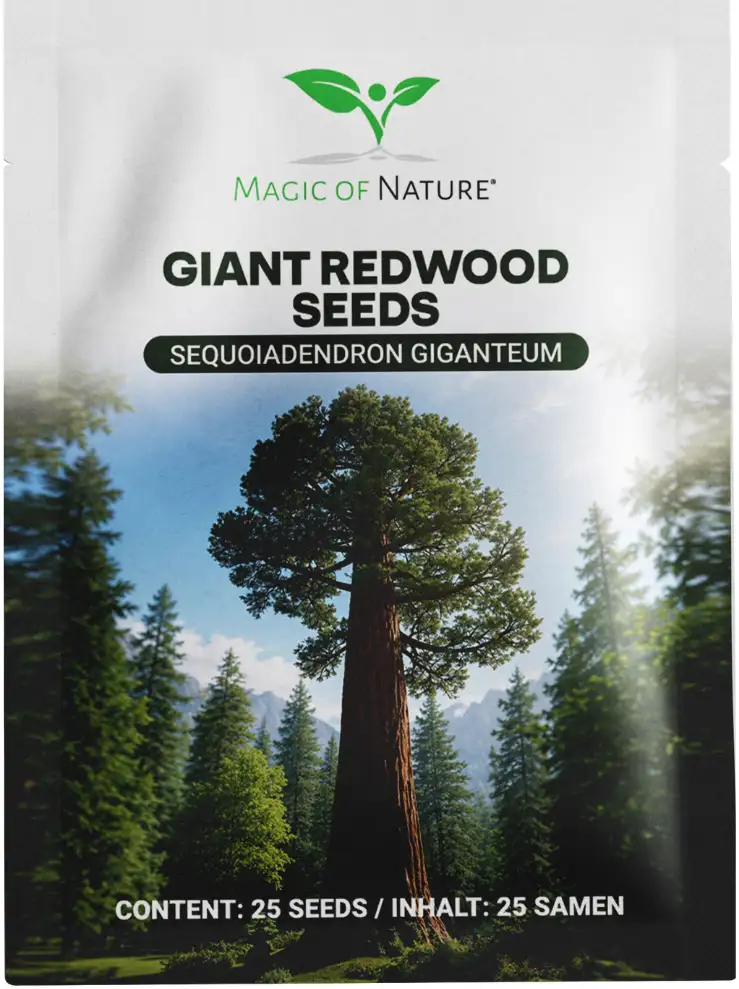
GIANT SEQUOIA
(Sequoiadendron giganteum)
PROFILE:
- Cultivable as a tree or bonsai – Sequoiadendron giganteum
- Growth height: up to 30 meters (under cultivation)
- Indoor cultivation from seeds is possible all year round
- Winter hardy: The giant sequoia is renowned for its extreme longevity and robustness

DESCRIPTION:
The giant sequoia is native to the western slopes of the Sierra Nevada in California, at altitudes between 1,350 and 2,500 meters. Outside its native habitat, the giant sequoia is now widespread worldwide due to intentional planting. In Western and Central Europe, it has been cultivated since the mid-19th century as a largely winter-hardy park tree. The sequoia is an evergreen woody plant. In its natural environment, it can grow over 100 meters tall, reach an age of more than 2,500 years, and achieve a trunk circumference of up to 10 meters. This makes it one of the most famous and massive trees on Earth.
CULTIVATION:
Indoor cultivation from seeds is possible all year round. The seeds must be stratified (cold-treated) before sowing. This means simulating the cold season, as the seeds naturally germinate in spring. Nature has equipped the seeds of many tree species with this germination inhibitor to prevent them from growing immediately after falling in autumn, which would result in a massive loss of seedlings. To stratify, place the seeds in the refrigerator (approx. 5°C) for 10 days to two weeks. Information regarding the exact duration of stratification varies depending on the source, ranging from three days up to two months.
After stratification, soak the seeds in lukewarm water for 12–24 hours. Afterward, place the seeds on seed-starting soil in a pot or tray. Giant sequoias are light germinators. This means the seeds must not be covered with soil. Keep the seeds and the container warm and moist. Ventilate the propagation container regularly to avoid mold formation! The germination period is between 2 and 5 weeks.
For further cultivation, partially shaded, sheltered locations should be preferred. The giant sequoia strictly requires moist and nutrient-rich soil. Waterlogging must be avoided. From the third year onward, the young trees can be planted outdoors. Young trees should be protected from severe frost during their first few years.
Please note:
This is a natural product. Therefore, we generally cannot assume a sprouting or germination guarantee for seeds, as the conditions under which sowing was carried out by the customer cannot be assessed or influenced by us.