
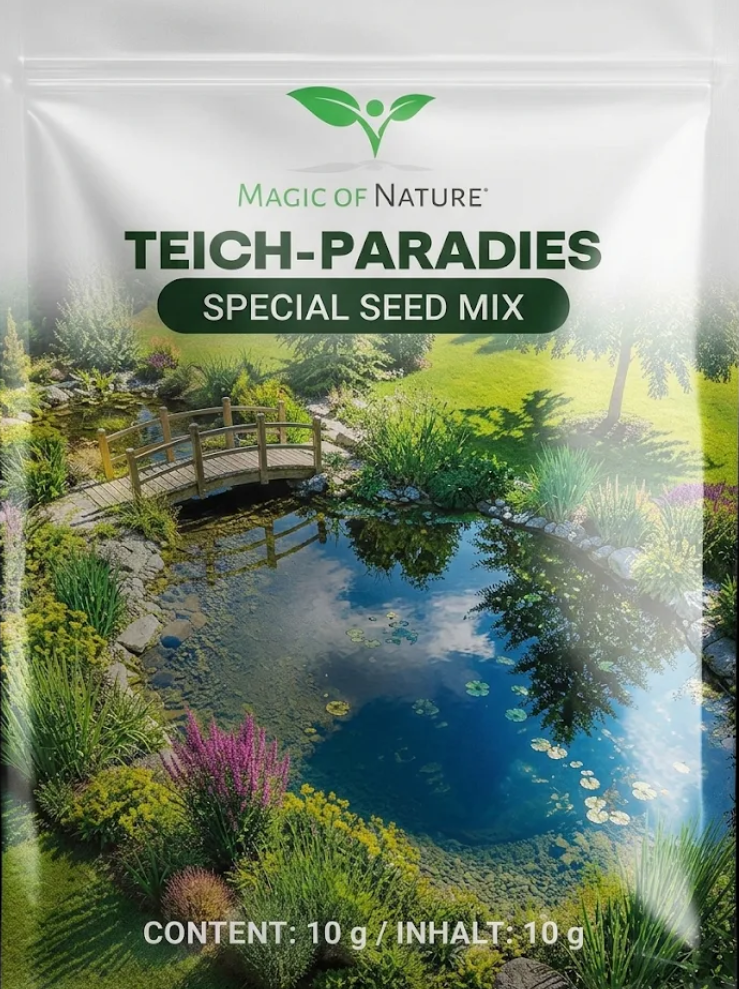
POND PARADISE
SPECIAL SEED MIX
(10 g for 5 m² Bank Zone)
26 Different Varieties of Native Wildflower & Wetland Plant Seeds
Important Note Before Opening the Seed Packet:
When you open the packaging, you will notice that the seeds form a fluffy, wool-like nest. This is pure intention by nature! Many of our high-filtration reed and wetland species (such as common reed and cattails) naturally possess extremely fine seed hairs. In their unfiltered state, these interweave to form this natural fleece. It protects the delicate seeds during transport and, in nature, ensures that the seeds can float on the water. This is an absolute premium quality feature of untreated, natural seeds.

The Perfect Timing:
Best Sowing Time: In spring (March to June), as soon as soil temperatures rise permanently.
Alternative: Sowing in early autumn (September/October) utilizes natural winter frost to activate hard-shelled rush seeds in the spring.
The Right Zone (Where to Sow?):
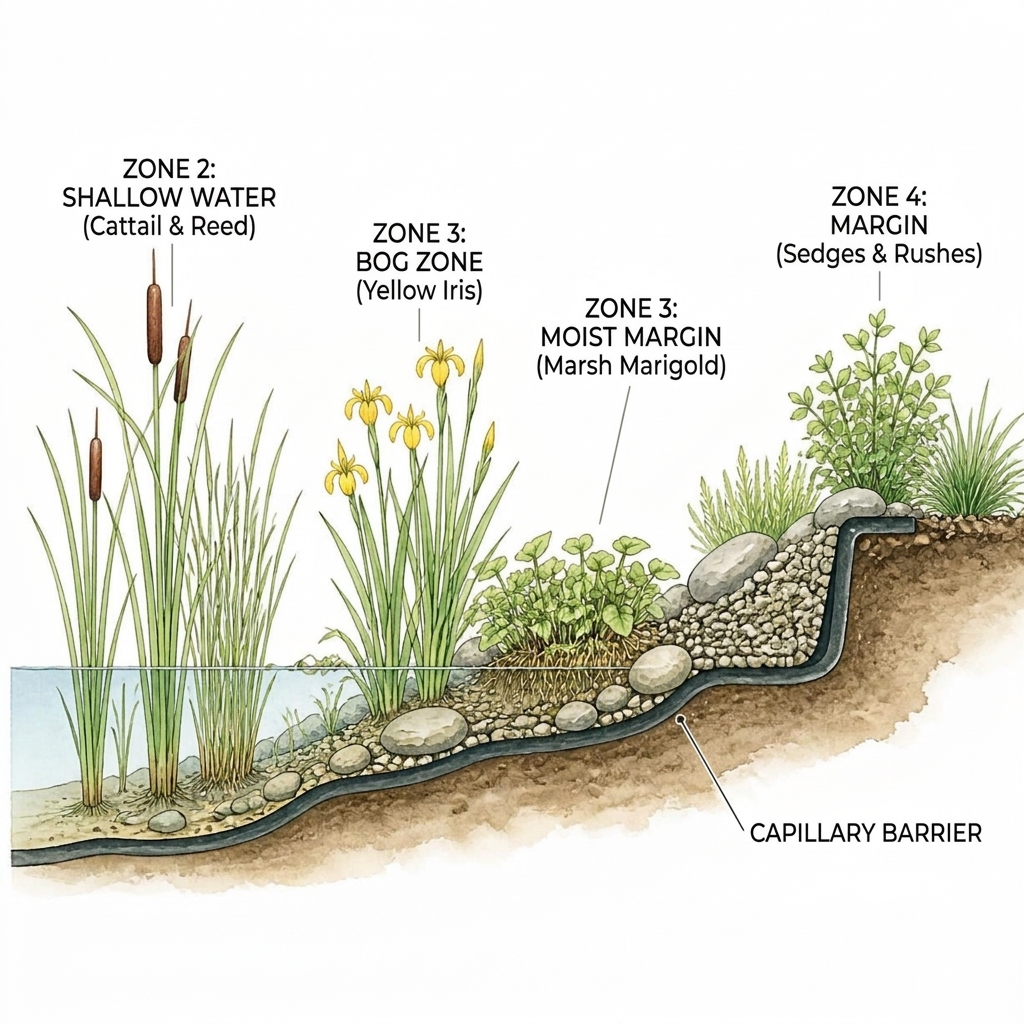
This mix has been specially developed for Zones 2, 3, and 4 of your garden pond. Please refer to the diagram:
- Zone 2 (Shallow Water): Permanently 10 to 50 cm underwater (e.g., reeds & cattails).
- Zone 3 (Marsh Zone): Permanently wet, muddy soil directly at the waterline (0 to 10 cm water depth).
- Zone 4 (Damp Bank): The moist soil just above the permanent waterline.
Note: Not suitable for deep open water (Zone 1) or dry garden beds.
Step-by-Step to the Perfect Waterfront Oasis
Step 1: Preparing the Bank
The seeds need direct soil contact to germinate. The muddy or earthy bank should be free of rampant weeds or thick decorative gravel. Alternatively, sowing directly onto laid pond bank mats, embankment mats, or coir (coconut fiber) mats that soak up water works perfectly.
Step 2: The “Pluck & Roll” Technique (Preventing Seeds from Blowing Away)
Since the seeds are extremely lightweight, choose an absolutely windless day for sowing. Open the packet carefully. Pluck the woolly seed nest apart into smaller flakes. To prevent them from blowing away in the air, you can lightly roll the flakes between damp hands into loose, small balls.
Step 3: Sowing (2 to 3 Grams per m²)
Distribute the seed flakes and the flat, brown iris seeds found between them evenly onto the muddy soil or the wet bank mat.
Important: The seeds are light-germinators (Lichtkeimer)! Never cover the seeds with soil. Simply press the seeds firmly against the damp surface using flat hands, a board, or a small roller.
Step 4: The Germination Phase (Patience is Required!)
Keep the sowing area consistently soaking wet for the first 4 to 6 weeks.
Biological Fact: Since this is 100% pure wild seed, the species have a natural, staggered germination inhibition. The plants do not all shoot up at the same time! The first grasses and herbaceous bank flowers will appear after 10–14 days. Hard-shelled rushes and sedges often germinate weeks or months later. Have patience – nature regulates this perfectly.
Alternative Method:
Controlled Propagation in Seed Trays
If you want to design your pond margin with pinpoint accuracy, have fish (e.g., Koi) in the pond, or want maximum control over germination, we recommend pre-cultivating in flat trays.
- 1. The Right Container & Substrate:
Use flat seed trays or plant pots without drainage holes (or place them in a closed bottom tray). Unfertilized seed compost, fine sand, or a soil-sand mixture is suitable as a substrate. Rockwool propagation cubes or coconut fiber mats also work excellently. - 2. Sowing (Light-Germinators):
Pluck a small flake of the woolly seed nest and press it flat onto the thoroughly moistened soil. Since these are light-germinators, the seeds must NEVER be covered with soil! Only press down gently with your fingers or a spray bottle. - The “Marsh Simulation” (Keep Permanently Wet):
This is the most crucial step: the substrate must never dry out! Keep the soil permanently soaking wet (like muddy sludge). Always fill the bottom tray about 1–2 cm high with water so the soil can draw moisture from below. - 4. Location & Temperature:
Place the trays in a bright, warm location (windowsill, conservatory, or greenhouse) at temperatures between 15°C and 22°C. - 5. Planting Out at the Pond:
After a few weeks, the first pioneers (marsh flowers and fast-growing grasses) will have formed strong, green stalks and a stable root system. Now you can carefully remove the young plants from the tray as small plugs (clumps) and plant them specifically into the marsh or shallow water zones (Zones 2, 3, and 4) of your pond. Simply press them firmly into the mud or insert them into the pockets of your bank mat.
Special Tip for Koi Pond Owners:
Koi love young plant shoots! If you have fish, either sow the Pond Paradise mix in a separate, isolated filter ditch or protect the germination zone in the pond with a fine protective mesh/guard until the plants are large and strong enough.
Species List: Overview of the 26 Individual Seed Varieties
Blooming Marsh & Bank Plants
(The Visual Highlights)
- Caltha palustris: Marsh-marigold
- Iris pseudacorus: Yellow flag iris (Yellow iris)
- Lythrum salicaria: Purple loosestrife
- Epilobium hirsutum: Great willowherb (Hairy willowherb)
- Ranunculus repens: Creeping buttercup
Filter & Reed Plants
(The Biological Purification System)
- Phragmites australis: Common reed
- Typha spp.: Cattail / Bulrush (various native species)
- Sparganium erectum: Branched bur-reed
- Schoenoplectus lacustris: Lakeshore bulrush (Common club-rush)
- Scirpus maritimus: Sea club-rush
Sedges & Umbrella Sedges
(Soil Stabilizers & Nutrient Absorbers)
- Carex acuta: Slender tufted-sedge
- Carex acutiformis: Lesser pond-sedge
- Carex pendula: Pendulous sedge
- Carex muricata: Prickly sedge
- Cyperus longus: Galingale (Long galingale)
- Carex riparia: Greater pond-sedge
Rushes & Grasses
(Structure Providers & Erosion Control)
- Juncus acutiflorus: Sharp-flowered rush
- Juncus acutus: Sharp rush (Spiny rush)
- Juncus subulatus: Keeled rush
- Juncus maritimus: Sea rush
- Scirpoides holoschoenus: Round-headed club-rush
- Phalaris aquatica: Bulbous canarygrass
Aromatic Wild Herbs & Ground Cover
- Mentha aquatica: Water mint
- Mentha pulegium: Pennyroyal
- Mentha rotundifolia: Round-leaved mint (False apple mint)
- Nasturtium officinale: Watercress