
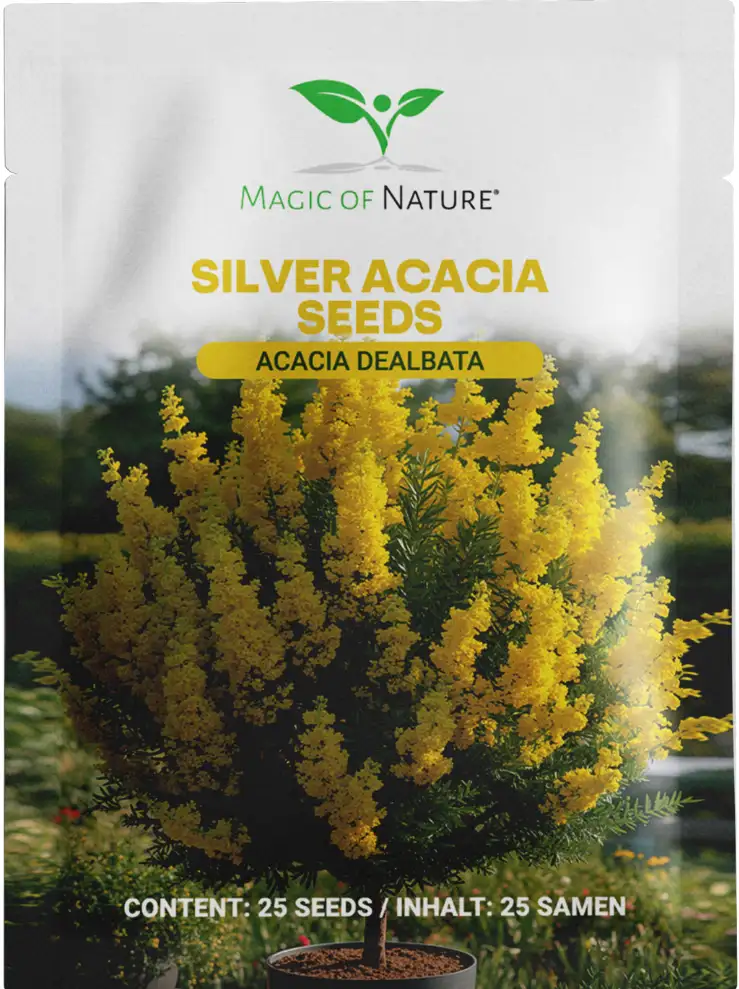
SILVER WATTLE
(Acacia dealbata)
PROFILE:
🛒 Available on our Etsy Shop ➔
- 25 seeds / pack – Acacia dealbata – A true ornament with Mediterranean flair
- “Florist’s Mimosa” – Cultivable as a tree or bonsai
- Popular container plant with magnificent yellow blossoms
- Indoor cultivation is possible all year round

DESCRIPTION:
The silver wattle, also known as the mimosa tree, is certainly one of the most beautiful acacia species. With its bright yellow mimosa blossoms and its feathery, dense, blue-green to silvery foliage, this plant—which can grow into a small to medium-sized tree when planted in the ground—is sure to be a highlight on your patio or in your conservatory. Originally from Australia, it is now native to many southern countries. The plant was introduced to Cannes in southern France around 1860. Today, the famous Mimosa Route, which is approximately 150 km long, is located there. Hundreds of thousands of trees and billions of blossoms line the roadsides, glowing and fragrant. When the mimosa stems are cut as cut flowers in southern France, spring is not far away. The mimosa tree makes a wonderful container plant, and its blossoms last significantly longer on the plant than in a vase.
CULTIVATION:
Indoor cultivation from seeds is possible all year round. Since the seeds absorb water rather poorly, you should roughen them slightly with sandpaper or a nail file to overcome their hard seed coat. This accelerates germination, as untreated seeds can take a year or longer to start germinating. Afterward, soak the seeds in lukewarm water for 24 hours. Then plant the seeds about 0.5–1 cm deep in coco coir or seed-starting soil. Seeds that have not swollen can be sorted out before planting. The silver wattle germinates at a temperature of approx. 25°C. It is important to keep the seed-starting soil constantly moist. However, waterlogging must be avoided. It is best to cover the propagation container with clear foil or glass. Ventilate regularly to avoid mold formation.
The first seedlings appear after approx. 2–4 weeks. This acacia species is not frost-resistant and prefers a bright, airy wintering location between 5°C and 15°C. Dark rooms are not suitable.
PLEASE NOTE:
This is a natural product. Therefore, we generally cannot assume a sprouting or germination guarantee for seeds, as the conditions under which sowing was carried out by the customer cannot be assessed or influenced by us.